
Chemical Energetics (also known as Thermochemistry) is a very important topic in Thermodynamics and is a highly application topic in A-Level H2 Chemistry Examinations.
In it, Hess’ Law and the use of Energy Cycle Diagrams is of utmost importance. Let’s take a look at some of the key concepts of Hess’ Law.
Hess’ Law of Constant Heat Summation:
It is defined as the enthalpy change (ΔH) of a particular reaction is determined only by the initial and final states of the system regardless of the pathway taken.
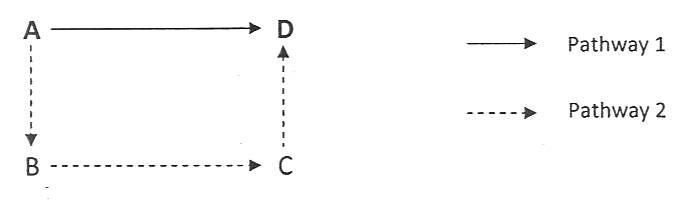
By Hess’ Law,
Enthalpy change for Pathway 1 = Enthalpy change for Pathway 2
ΔH (for A → D) = ΔH (for A → B) + ΔH (for B → C) + ΔH (for C → D)
Uses:
Application of Hess’ Law is particularly useful when the enthalpy change of a reaction cannot be determined directly by experiment. In this cases, we will use Hess’ Law to calculate the enthalpy change from other data that is available (individual steps) and can be experimentally determined. A very common application of Hess’ Law is the Born-Haber Cycle which is used to determine the lattice energies of ionic solid compounds.
If you have not read my previous post on the definitions of Standard Enthalpy Changes of Reactions, you should do so before moving on.
Energy Cycle Diagrams:
For calculations to be clear, we often draw an Energy Cycle Diagram which is made up of individual steps that link the initial and final states of the system.
3 Steps to calculate Enthalpy Changes (ΔH) of a reaction using Hess’ Law:
Step 1: Write down the equation representing the enthalpy change which you are required to calculate.
Step 2: Construct a fully labelled energy cycle according to the data provided, including state symbols.
Step 3: Apply Hess’ Law to calculate the required enthalpy change.
The two most common applications are:
A) Calculations involving Enthalpy Changes of Formation
B) Calculations involving Enthalpy Changes of Combustion
Let us look at two exam-based questions and see how we apply it to solve the questions.
A) Calculations involving Enthalpy Changes of Formation
Question 1:
Calculate the enthalpy change for the reaction CaF2 + H2SO4 → 2HF + CaSO4, given that the enthalpies change of formation of CaF2, H2SO4, HF and CaSO4 are -1220, -814, -271 and -1434 kJmol-1 respectively.
Solution:

By Hess’ Law, ΔHrθ = 2(-271) + (1434) – (-1220) – (-814) = +58 kJmol-1
B) Calculations involving Enthalpy Changes of Combustion
Question 2:
Calculate the standard enthalpy change of formation of CH4 given than the standard enthalpies change of combustion of methane, graphite and hydrogen are -890.2, -393.4 and -285.7 kJmol-1 respectively.
Solution:
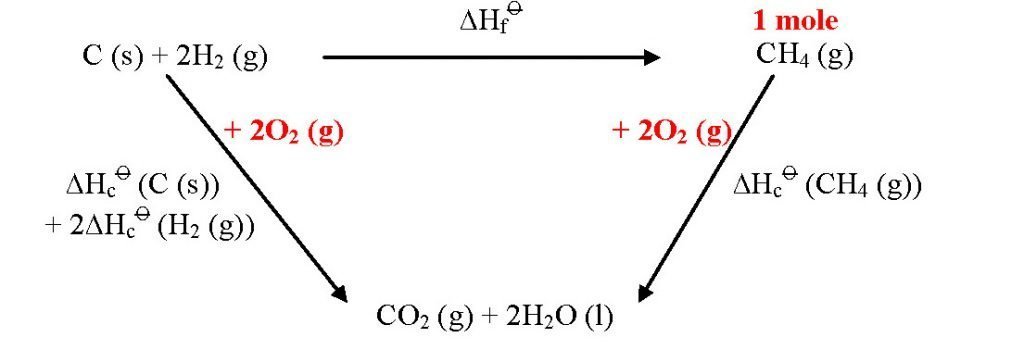
By Hess’ Law, ΔHfθ = -393.4 + 2(-285.7) – (-890.2) = -74.6 kJmol-1
I highly encouraged you to work on more H2 Chemistry Exam questions which are related to Chemical Energetics. Practice does make perfect, particularly for this topic. Our students are given a lot of Energetics’ questions to work on.
I hope you find the content easy for your understanding and if you have any questions, leave me a comment below. Feel free to share this blog post with your friends.
Subscribe to my blog to receive 2 updates per month sent to your email!
PS: Under related articles below, there are several blog post discussions and questions related to Chemical Energetics. You can also do a keyword search using the search box at the top right hand corner.
PPS: If you need help with your A-Level H2 Chemistry, do join us in our weekly A-Level H2 Chemistry Tuition Class.
Related Articles:
- Chemical Energetics: Experimental Method to Determine Enthalpy Change of Combustion
- Chemical Energetics: Definitions of Standard Enthalpy Changes of Reactions
- Chemical Energetics: Exam-Based MCQ Question on Hess’ Law & Energy Cycle
- Chemical Energetics: Gibbs Free Energy in Thermodynamics
- Chemical Energetics: Application of Gibbs Free Energy in Thermodynamics
I love the examples they were really helpful
Major thanks for the blog.Really looking forward to read more. Want more.
I am so grateful for your blog.Thanks Again. Keep writing.
Hi! I’ve been following your blog for a long time now and finally got the courage to go ahead and give you a shout out from Atascocita Texas! Just wanted to mention keep up the great job!
Hi Rod,
Thank you for your encouraging words.
Glad you find this A-Level Chemistry (Advanced) blog useful to you.
Sean Chua
This is good however im confused. On the 2nd example it says caluclate the enthalpy of formation, however enthalpy of combustion has been used. Why is that? Please get back asap. Thanks
Thanks for above and please explain in detail next….
Hi Animit. The question is indeed asking us to calculate the enthalpy change of formation and in order to do so, we need to use all the other standard enthalpy change of combustion information to set up the energy cycle and then solve it using Hess’ Law.
Regards,
Sean Chua